



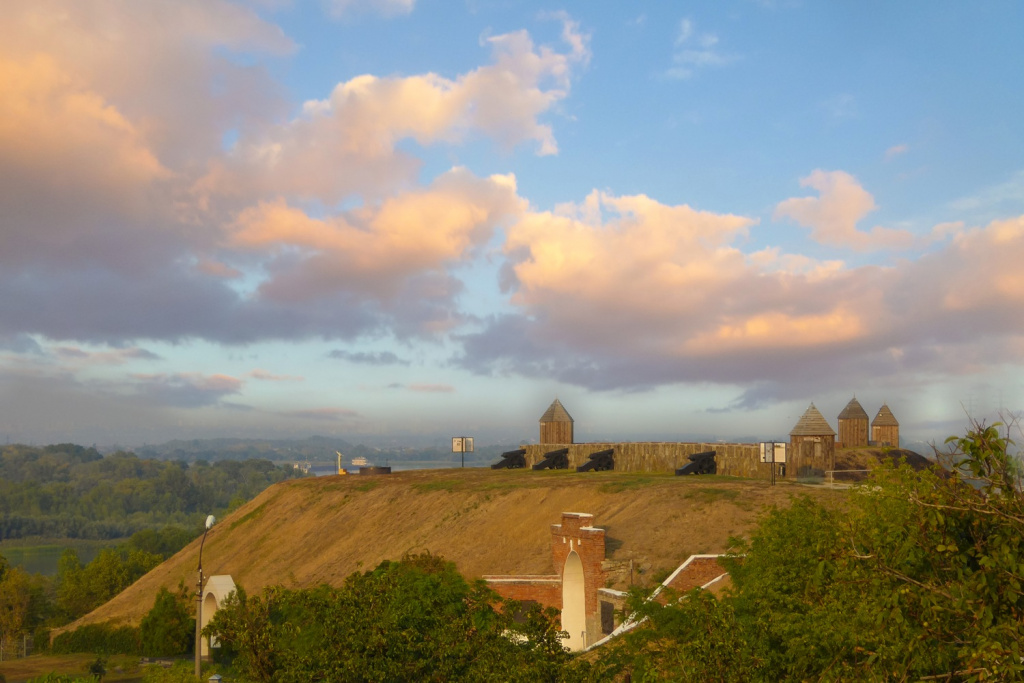
The Azov Fortress, the most impressive and large–scale attraction of the city, after its stunning museum, is, of course, a reconstruction. From the ancient fortress, only two walls have survived to this day on the sides of the Alekseevsky Gate – one of the eleven. They were excavated by archaeologists in 1935, and subsequently carefully restored. In addition to these gates, the existence of the fortress is only recalled by earthen ramparts stretching for hundreds of meters with a width of five to thirty meters. Reconstructions of the remains of ancient stone walls were erected on the crests of these ramparts, cannons made according to ancient models were installed, as well as copies of sentry booths of the XVIII century. The Azov Fortress was the first real stone fortress built on this site by the Genoese in the XIII century. It was adjacent to the Horde city of Azak-Tana and was a fortified point, a transshipment base of a very powerful and powerful trading republic of Genoa during the early Middle Ages. Subsequently (since 1475), the fortress belonged to the Ottoman Turks, who strengthened and rebuilt it in their own way. After the expulsion of the Turks, the garrison of the Azov fortress consisted of Cossacks and Russian soldiers. Now there is a wonderful walking area here. Along the ramparts there are beautiful, richly illustrated stands with visual descriptions of the history of Azov, uniforms and weapons of past eras. This makes the walk very interesting and informative. There is also a curious art object: a stone landmark sign in the form of a compass. It shows the cardinal directions and directions to other fortresses that formed the defensive system of the southern borders of Russia in the XVIII century. The Azov-02 Fortress offers a stunning view of the Don Delta from here, from the high bank of the river. With at least minimal imagination, you can imagine how the siege and assault of this powerful fortification on the high-rise was organized, and what were the chances of success. And once a year – and see with your own eyes. Every year, the All-Russian Festival of military-historical clubs takes place in the Azov Fortress, with costumed dramatizations and reconstructions.
Location: Genoese Street.